
The short version: AVL puts every unit from every agency on one live, shared map, turning unified command from radio checks into real‑time coordination.
Mutual aid is the fire service’s oldest operating principle. Long before computers, fire chiefs were trading apparatus and personnel across boundaries to help neighbors in trouble.
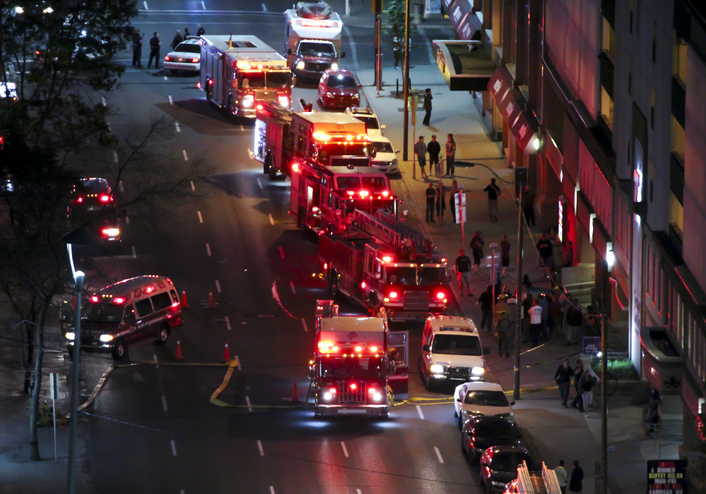
That tradition has scaled enormously. A modern large-scale incident, a major wildland fire, a multi-alarm structure fire in a downtown core, a hazardous materials release, a natural disaster, routinely involves dozens of agencies, hundreds of personnel, and resources arriving from multiple states.
The operating principle hasn’t changed. The coordination problem has. When the on-scene commander is managing five engines and two ladders, mental tracking and radio traffic still work. But, when unified command is coordinating 150 apparatus from 40 agencies across three operational periods, mental tracking breaks down and radio traffic overloads.
During a multi-agency incident, the resource you can’t see is a resource you can’t use. Real-time AVL data, shared across all participating agencies on a single operational picture, is what closes that gap.
This article explains how AVL supports mutual aid and large-scale incident coordination, where most platforms fail at multi-agency operations, and what fire departments should evaluate when they plan a deployment that has to work across agency boundaries.
Why multi-agency coordination is uniquely difficult
Single-agency AVL is a relatively contained engineering problem: single vendor, single CAD, single set of policies, single command structure. Multi-agency operations break every one of those assumptions.
Different vendors and systems. Each agency typically owns its own CAD, AVL platform, communication system, incident management software, and GIS data. A multi-agency incident is, by definition, an integration problem, even when every agency is doing its job perfectly within its own boundaries.
Different command structures and authorities. Unified Command is the Incident Command System (ICS) answer to multi-agency operations. It lets representatives from each agency collaborate on incident objectives while keeping their own authority and chain of command. But Unified Command only works if the participants can see the same picture. Without shared situational awareness, it becomes a meeting that can’t reach decisions.
Different data-sharing policies. Agencies have legitimate reasons to control what they share. Personnel records, ongoing investigations, sensitive pre-plans, and security-classified locations may not be appropriate to expose during a mutual-aid response. The strongest platforms support granular permission controls so each agency decides exactly what it shares and with whom.
Rapid scaling. Mutual aid scales fast: a small incident becomes a regional incident in an hour, an interstate incident by the end of the operational period. The platform has to onboard arriving resources, from agencies that may never have worked with the host system, without requiring software installation or training mid-incident.
Connectivity degradation. Large-scale incidents happen where infrastructure is strained, damaged, or destroyed. The platform has to function across that environment, not just in the ideal case.
How AVL supports multi-agency coordination
- A single common operating picture across agencies. Every responding unit, host agency, automatic aid partners, mutual aid from multiple counties, CAL FIRE or other state agencies, federal interagency resources, out-of-state strike teams arriving via EMAC, appears on the same map, clearly identified by agency, with accurate position and status. This is the single biggest change to how multi-agency operations function. The IC at unified command no longer needs to poll agency representatives for unit positions and counts. The information is on the screen, continuously updated.
- AVL sharing with granular permission controls. Modern platforms let agencies elect to share vehicle locations with mutual-aid partners on compatible systems, with clear agency identifiers supporting unified command and crew safety. The strongest platforms let each agency decide:
- Which units to share: all apparatus, or only those committed to multi-agency operations
- What attributes to expose: position and status only, or full unit detail including staffing and capabilities
- Who can see what: different visibility for partner agencies inside a mutual-aid agreement versus visiting strike teams under unified command
- Duration of sharing: permanent for automatic aid relationships, incident-scoped for ad hoc mutual aid
- Interoperability across CAD and communication systems. Multi-agency operations span multiple CAD vendors, communication systems, and incident management platforms. The strongest platforms use open standards and configurable data schemas to support mutual aid without forcing everyone onto the same vendor or workflow. Closed-ecosystem platforms create silos that fail at exactly the moment shared awareness matters most.
- Rapid onboarding for arriving resources. When a strike team arrives from 400 miles away, there’s no time to install software or run training. The best platforms support lightweight onboarding through standard data feeds and minimal local installation, ideally no more than a vehicle identifier exchange and a connectivity check.
- A common operating picture for unified command. Real-time AVL data feeds the unified command post with a continuously updated view of all resources committed to the incident, organized by agency, division, group, or any other ICS structure. This is what makes unified command function as a decision body rather than a coordination meeting.
- Mutual aid pre-arrival data sharing. When mutual aid is dispatched, the responding crew benefits from pre-arrival access to the host agency’s pre-plans, hydrant locations, hazmat storage data, and other operational information. Platforms that share data as part of the dispatch process, not just AVL position, give responding crews critical context before they arrive.
- After-action documentation. Every position, status change, and assignment from every agency is timestamped and logged, supporting After Action Reviews, NIMS reporting, ICS-209 documentation, EMAC reimbursement, and the broader continuous-improvement effort.
What makes an AVL platform truly multi-agency capable
- Open standards and configurable schemas: open APIs, support for multiple CAD vendors, and schemas that accommodate the operational vocabulary of different agencies
- Granular permission and sharing controls: per-agency, per-unit, per-attribute, time-bounded sharing, with audit logs of what was shared and when
- Multi-agency AVL sharing: native support for sharing vehicle positions across agencies on compatible platforms, with clear identifiers and accurate status in real time
- Rapid onboarding for visiting resources: lightweight processes for adding arriving strike teams without full software deployment
- Multi-bearer connectivity: multi-carrier cellular, LEO satellite, and LMR fallback so the platform stays online across degraded networks
- ICS and Unified Command alignment: a data model that maps to divisions, groups, branches, sections, and unified command, so the picture organizes information the way command staff already think
- Compliance with emerging standards: NERIS for fire reporting, NIMS resource typing, EMAC documentation, and other interagency frameworks
Frequently asked questions
Can different agencies using different AVL vendors see each other’s units?
Yes, when the platforms support open standards and interoperability. The data appears on the common operating picture with clear agency identifiers. Platforms that only support their own proprietary format cannot participate in true multi-agency operations.
How does AVL support Unified Command?
Unified Command depends on shared situational awareness. Real-time AVL data feeds the command post with a live view of all resources committed to the incident, organized by agency and ICS structure. Every representative sees the same picture, supporting collaborative objective-setting and resource allocation.
What about EMAC and out-of-state mutual aid?
Strike teams arriving via the Emergency Management Assistance Compact (EMAC) need to be brought onto the operational picture quickly. The strongest platforms support lightweight onboarding, and EMAC documentation, resource hours, assignment tracking, demobilization records, is supported by the platform’s logging and analytics.
How are sensitive data and operational information protected during mutual aid?
Granular permission controls let each agency decide what to share, with whom, and for how long. A department might share pre-plan and hydrant information freely while restricting personnel records or sensitive locations. Audit logs document what was shared during each incident.
Does multi-agency AVL coordination work in remote wildland terrain?
Only if the connectivity stack is built for it. Multi-bearer SD-WAN with cellular and LEO satellite backup is essential. Platforms that depend on single-carrier LTE will lose visibility on portions of the operational picture exactly when coordination matters most.
How does AVL integrate with the broader Incident Command System?
AVL is a tool that supports ICS, not a replacement for it. The command structure, chain of command, and planning process all remain intact. AVL provides the data that lets each level of the ICS structure see the resources under its span of control.
What about volunteer and combination departments participating in mutual aid?
They’re essential to mutual aid in most regions and often have different IT capabilities than career departments. Strong platforms support tiered participation. Volunteer departments may participate as recipients of operational data even without full AVL in every apparatus.
What fire departments should evaluate for multi-agency AVL
- Multi-agency AVL sharing: native position sharing across agencies on compatible platforms
- Granular permission controls: per-agency, per-unit, per-attribute, time-bounded rules
- Open standards: interoperability across CAD vendors, communication systems, and incident management platforms
- Rapid onboarding: lightweight processes for adding arriving resources
- ICS-aligned data model: organization by division, group, branch, section, and unified command
- Multi-bearer connectivity: cellular, LEO satellite, and LMR fallback
- Compliance support: NIMS resource typing, NERIS reporting, EMAC documentation, ICS-209 alignment
- Audit and after-action: timestamped logs of position, status, and sharing activity for every agency on every incident
The bottom line
Mutual aid will keep scaling. WUI expansion, climate-driven incident severity, and rising operational complexity all push more incidents into multi-agency territory. The agencies that operate effectively across that landscape will be the ones whose AVL platforms were built for it from the start: open standards, granular permissions, multi-agency sharing, ICS-aligned data, and the connectivity to keep the picture populated across degraded networks.
Unified Command was designed to bring agencies together. AVL is what gives Unified Command the data to make decisions on. For fire service leaders planning for 2026 and beyond, multi-agency AVL capability isn’t a feature. It’s foundational.
Why fire agencies choose RadioMobile for multi-agency operations
After supporting CAL FIRE and many of the largest fire agencies in California, agencies that operate across complex mutual aid, automatic aid, and interstate EMAC relationships every fire season, we’ve learned that a platform is only as good as the picture it holds together when a hundred apparatus from forty agencies show up at once.
RadioMobile supports multi-agency AVL sharing with granular permission controls, integration across CAD vendors and radio systems, ICS-aligned data organization, and Unified Command workflows. Multi-bearer SD-WAN connectivity, bonding FirstNet, Verizon, and T-Mobile cellular with Starlink and OneWeb LEO satellite, keeps the common operating picture populated even when networks degrade. Integration with Tablet Command, TC Mobile, FireMapper, and leading CAD platforms ensures every participating agency, host, partner, strike team, or visiting resource, works from the same operational picture. And RadioMobile partners with agencies long after deployment to keep multi-agency performance solid across the most complex incidents.
Learn more or schedule a discovery call at radiomobile.com.