Transforming Fleet Visibility and Operational Awareness with a Private Wireless AVL Network
The County of Los Angeles Fire Department needed dependable AVL and mobile data connectivity across a vast, complex service area where commercial broadband is not always available. RadioMobile custom-built a solution that uses LA County’s private wireless network, LTE/5G, and satellite-ready connectivity to keep units visible, connected, and mission-ready when every second counts.
Transforming Fleet Visibility and Operational Awareness with a Private Wireless AVL Network
How LA County Fire ensures continuous unit location tracking, resilient connectivity, and mission‑critical data sharing across its entire service area
When commercial broadband is unavailable or unreliable, fire chiefs still need confidence that dispatchers can see where units are, responders can exchange critical information, and command staff can maintain operational awareness. This success story shows how the County of Los Angeles Fire Department uses a custom, private wireless AVL network from RadioMobile (RMI) to extend dependable unit location tracking and mission-critical data sharing across one of the nation’s largest and most complex service areas.
THE NEED
Continuous AVL Visibility Beyond LTE Coverage
The County of Los Angeles Fire Department (LACoFD) protects more than 4 million residents across 2,300 square miles of dense urban centers, suburban neighborhoods, beaches, open water, and mountainous terrain. Nearly 100 dispatchers manage close to 400,000 incidents each year—making accurate unit location, reliable status updates, and uninterrupted connectivity essential to safe and efficient operations.
Commercial LTE coverage varies dramatically across the region, especially in canyons, remote areas, and disaster‑impacted zones. LACoFD needed a mobile data and AVL solution that would:
Provide real‑time unit location tracking regardless of LTE availability
Connect every mobile data computer (MDC) and every fire station to the Emergency Communications Center (ECC)
Support dispatch details, responder status, digital messaging, and map updates
Reduce reliance on commercial broadband for cost, resilience, and security and provide backup connectivity when cellular service is unavailable
“The Department required a system that allowed personnel to share critical situational information regardless of the availability of an LTE network.”
Telecom Consulting Engineer Scott England
THE CHALLENGE
A Vast, Complex Service Area with Uneven Connectivity
LACoFD’s geography creates persistent communication challenges:
Mountain ranges and canyons obstruct LTE signals
Coastal and open‑water operations require long‑range coverage
Wildfire and disaster conditions frequently degrade commercial networks
High‑noise RF environments that demand exceptionally selective radio equipment
The Department needed a secure, redundant, and self‑controlled network capable of delivering AVL and operational data everywhere responders operate—not just where LTE happens to be available. The solution also had to support high call volume, work across a mix of urban and remote environments, and remain useful during incidents when commercial networks could become congested, damaged, or unavailable.
THE SOLUTION
A Private Wireless AVL Network
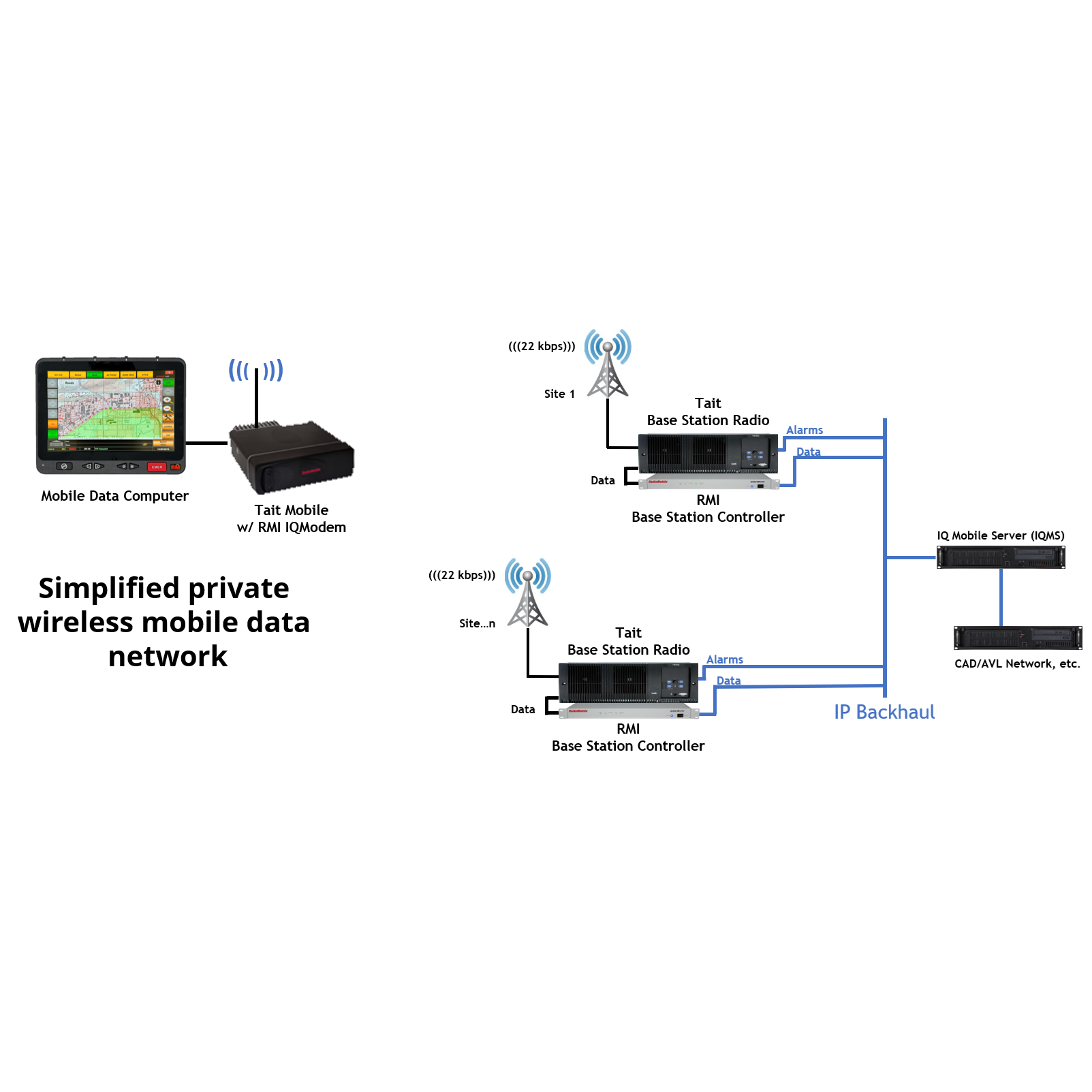
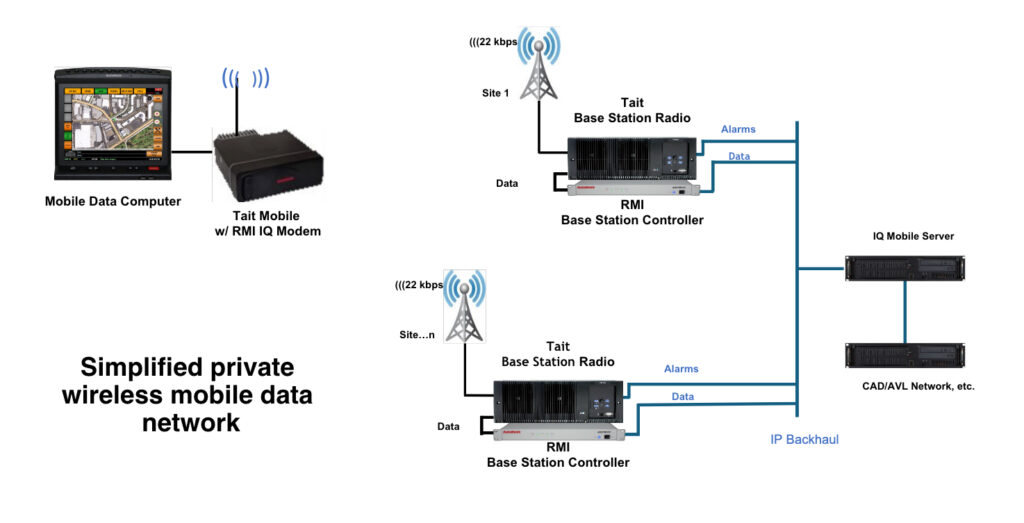
To meet these needs, LACoFD partnered with RadioMobile, Inc. (RMI), specializing in mobile data and AVL solutions for Fire and EMS agencies. RMI designed a custom, private LMR‑based mobile data network that integrates seamlessly with FSA/CAD/AVL systems and provides resilient, countywide coverage. By using Department‑controlled infrastructure as a dedicated data path, the network helps keep essential operational information moving even when commercial broadband cannot be counted on as the only communications layer.
Strategic LMR Site Deployment
The network includes 12 strategically placed LMR high‑sites operating narrowband UHF channels at 22 kbps. These high‑sites deliver long‑range coverage with fewer towers and are hardened within secure Department facilities.
Each site includes:
A Tait base station radio
RMI’s Base Station Controller (BSC)
IP backhaul integration with CAD/AVL
Tait base stations were selected for their sensitivity, selectivity, and adjacent‑channel performance—critical in Los Angeles County’s high‑noise RF environment.
Mobile and Station Equipment
Every apparatus is equipped with:
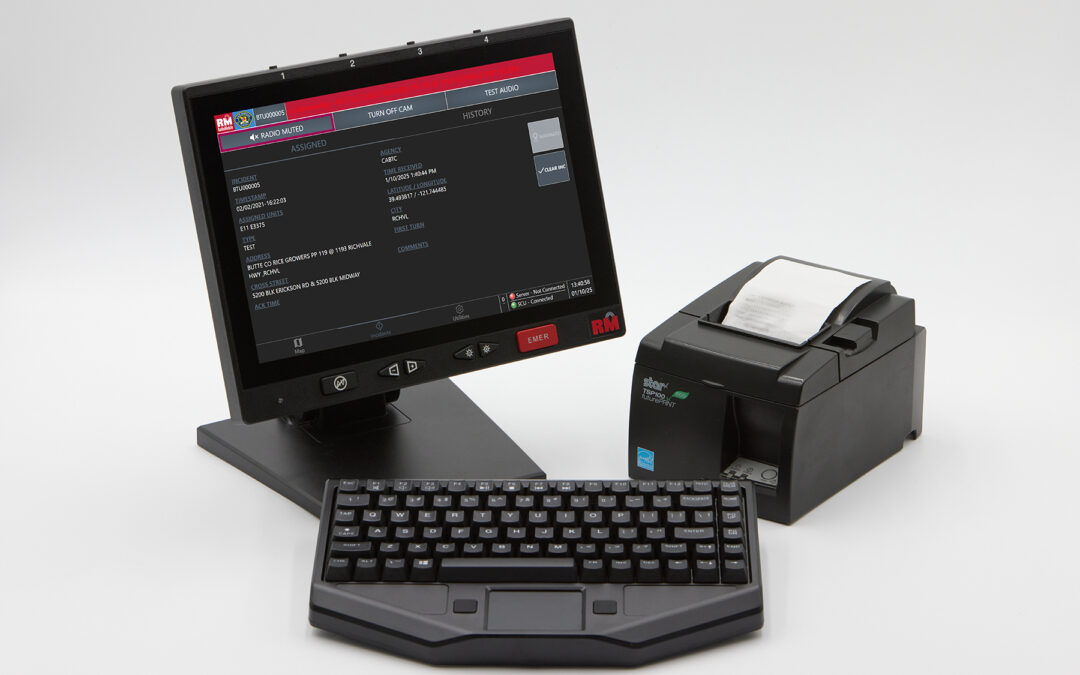
A mobile data computer (MDC)
A Tait mobile radio with an integrated RMI IQ Modem
The IQ Modem converts digital AVL and status data into a format suitable for analog transmission over LMR, ensuring continuous location reporting even when LTE is unavailable.
The Departments 177 fire stations use RMI’s IQ Fire Station Alerting System (IQ FSAS), which receives dispatch and alerting data through the same mobile data network for immediate station notification. The same information is also distributed to 1200 vehicles via the private wireless network.
Intelligent Multi‑Network Architecture
RMI’s architecture supports simultaneous use of:
LMR
LTE/4G/5G
Low‑Earth‑orbit (LEO) satellite connectivity
Using data channel aggregation, the system combines multiple broadband connections into a single, wider data path—ideal for bandwidth‑intensive applications such as real‑time video streaming, AVL map updates, and large data transfers.
This layered approach gives LACoFD flexibility to use the best available path for the type of data being transmitted. AVL and essential status information can continue over LMR when broadband coverage is limited, while higher‑bandwidth applications can take advantage of LTE, 5G, or satellite links when those services are available.
The RMI AVL system dynamically scales network usage based on real‑time connectivity—using online maps, video streaming, and cloud services when broadband is present, and automatically relying on locally stored maps, navigation, and map layers when only LMR is available.
THE RESULTS
A More Visible, Connected, and Resilient Fleet
With its LMR‑augmented AVL network, LACoFD is better equipped to protect lives, property, and the environment. The system gives dispatchers a more dependable view of where units are located, helps field personnel maintain data connectivity across difficult terrain, and strengthens the Department’s ability to coordinate resources during routine calls as well as large‑scale emergencies.
For an agency operating across one of the most geographically diverse regions in the country, that visibility is more than a convenience—it is a mission‑critical capability. When incidents unfold quickly, knowing the location and status of available resources can improve routing decisions, support faster coordination between responding units, and give command staff a clearer operational picture.
Key outcomes include:
Continuous AVL visibility even when LTE is unavailable or compromised
Reliable data sharing including preplans, dispatch details, and responder locations
Enhanced security through a closed, Department‑controlled network
Lower operational costs by reducing dependence on commercial LTE
Countywide Interoperability and Multi‑Layer Connectivity
LACoFD has integrated its private wireless mobile data network into the Los Angeles Regional Interoperable Communications System (LA‑RICS), which operates 22 high‑site LMR towers across the county. This integration enables seamless cross‑agency communication and AVL visibility among fire, law enforcement, EMS, and regional partners.
“Now that LA‑RICS is fully deployed as a countywide system, our firefighters—and all LA‑RICS member agencies—can share lifesaving data and communicate seamlessly across jurisdictions.”
Telecom Consulting Engineer Scott England
THE FUTURE
Ensuring Long-Term Operational Readiness
LMR remains a reliable backbone technology connecting thousands of public‑safety vehicles nationwide. Today, it operates alongside LTE/5G and low‑Earth‑orbit satellite systems such as Starlink, giving agencies multiple resilient connectivity options. RMI’s custom AVL platform is engineered for long‑term operational readiness, continuously integrating new capabilities as they become available.
That adaptability is central to the value of the solution. As LACoFD’s operational requirements evolve—whether through new applications, expanded data needs, additional partner agencies, changing coverage priorities, or emerging broadband and satellite technologies—the network can evolve with them. The architecture is not limited to a single transport method or fixed operating model; instead, it provides a flexible foundation that can incorporate new connectivity paths, support additional field devices, and scale to meet future demands while preserving the dependable LMR backbone that public safety operations require.
CAL FIRE strengthened statewide situational awareness with RMI’s automatic vehicle location (AVL) solution, improving fleet connectivity, vehicle location data, dispatch visibility, and responder accountability through resilient LTE/5G and satellite communications, ruggedized in-vehicle hardware, and integration with public safety software.
The County of Los Angeles Fire Department (LACoFD) provides fire protection and life safety services to more than 4 million residents of Los Angeles County, California across 2,300 square miles and 59 cities. With nearly 400,000 annual incidents and almost 200 fire stations, the Department relies heavily on its Fire Station Alerting System (FSAS) to accelerate response times and ensure mission critical communication.
To provide the best experiences, we use technologies like cookies to store and/or access device information. Consenting to these technologies will allow us to process data such as browsing behavior or unique IDs on this site. Not consenting or withdrawing consent, may adversely affect certain features and functions.
Functional
Always active
The technical storage or access is strictly necessary for the legitimate purpose of enabling the use of a specific service explicitly requested by the subscriber or user, or for the sole purpose of carrying out the transmission of a communication over an electronic communications network.
Preferences
The technical storage or access is necessary for the legitimate purpose of storing preferences that are not requested by the subscriber or user.
Statistics
The technical storage or access that is used exclusively for statistical purposes.The technical storage or access that is used exclusively for anonymous statistical purposes. Without a subpoena, voluntary compliance on the part of your Internet Service Provider, or additional records from a third party, information stored or retrieved for this purpose alone cannot usually be used to identify you.
Marketing
The technical storage or access is required to create user profiles to send advertising, or to track the user on a website or across several websites for similar marketing purposes.