
Picture the final hour of a grueling overnight shift. It’s 5:45 a.m., and the dispatcher has been at the console for nearly twelve hours, managing a relentless stream of calls. Suddenly, a working structure fire breaks out. The dispatcher must now simultaneously process a 911 follow-up, coordinate responding units on a tactical channel, and deliver a clear, precise station alert containing the address, cross streets, and specific unit assignments.
This scenario isn’t a critique of dispatcher performance; it is an acknowledgement of the extreme cognitive load we place on these professionals. Text-to-Speech (TTS) technology is designed specifically to mitigate this burden, transforming a high-pressure manual task into a reliable, automated process that has become a core feature of modern station alerting.
How TTS Integrates with CAD
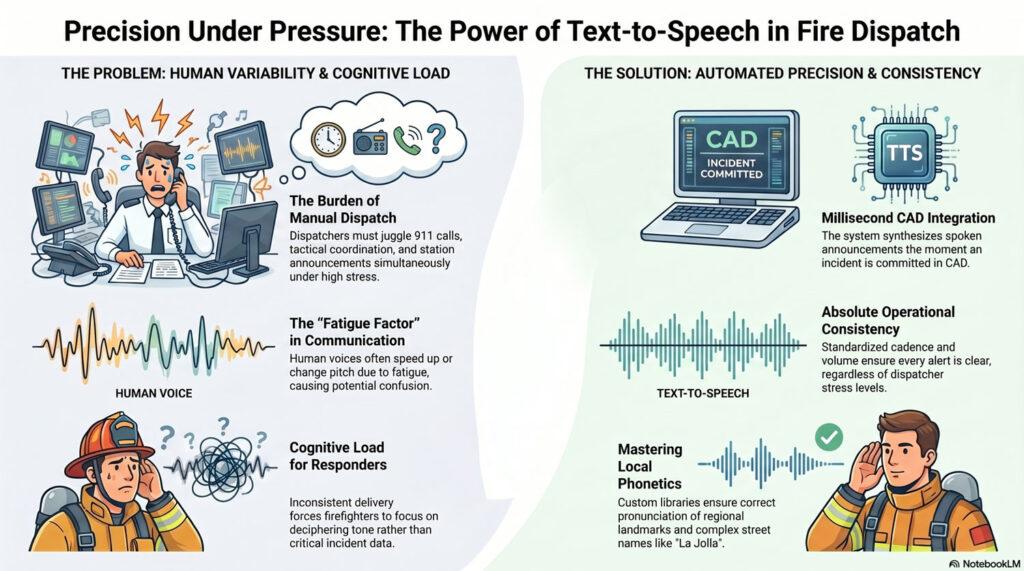
In a CAD-integrated alerting platform, TTS operates as a seamless extension of the dispatch workflow. The moment an incident is “committed” or updated in the CAD, the system pulls the structured data—incident type, address, map coordinates, and unit assignments—and synthesizes a spoken announcement instantly.
This automation removes the “middleman” from the verbal announcement process. There is no need for a dispatcher to key a microphone or repeat information; the system delivers the audio through station speakers within milliseconds of the data being entered. This ensures that the verbal alert is never delayed by a dispatcher who is tied up on a high-priority 911 call or managing an escalating radio channel.
Local Precision: Mastering Regional Phonetics
One of the most common concerns regarding automated voice is the pronunciation of unique local geography. Modern TTS engines have evolved far beyond the robotic tones of the past. They are now remarkably sophisticated, capable of handling complex technical terminology and, more importantly, local phonetic nuances.
Departments can configure pronunciation exception libraries to ensure the system handles regional dialects and historical names correctly. For example, the system can be programmed to recognize that a name like La Jolla requires a specific phonetic output that differs from its literal spelling. Whether it is a Spanish-influenced name, a French-derived street, or a local landmark with a non-intuitive pronunciation, the TTS engine is “taught” to speak like a local. This level of customization ensures that crews hear familiar, accurate directions, preventing the confusion that can arise from a mispronounced street name.
Consistency: The Core Operational Advantage
While the speed of TTS is impressive, the primary benefit for field personnel is consistency. With human-voice dispatch, the quality of a station announcement is subject to human variables like fatigue, stress, or ambient background noise in the dispatch center. Under pressure, a human voice often speeds up, changes pitch, or becomes clipped.
TTS eliminates these variables entirely. Every announcement is delivered with the same deliberate cadence, volume, and clarity—regardless of whether it is the first call of the day or the fortieth. By standardizing the delivery, the department reduces the cognitive load on firefighters. When the voice is always the same, the brain can focus entirely on the content of the message (the address and the nature of the emergency) rather than struggling to decipher the delivery or tone of the speaker.
Strategic Allocation of Human Expertise
It is important to note that TTS is not intended to replace the dispatcher’s role on the radio. Voice radio remains the lifeline for on-scene communications and tactical coordination. However, the initial station alert is a structured, data-driven event that is perfectly suited for automation. By offloading the routine verbal announcement to a TTS engine, the dispatcher is freed to focus on high-level tasks that require human judgment, such as providing life-saving pre-arrival instructions to callers or managing dynamic resource deployment during “all-hands” incidents.
Conclusion
If your department still relies on manual voice announcements for every station alert, it is worth evaluating the hidden costs of that process. The variability of human speech under pressure is a known point of failure in the dispatch chain. For departments prioritizing rapid response and clear communication, moving to a CAD-integrated TTS system replaces human inconsistency with machine-level precision, allowing your dispatchers to focus where their expertise is needed most.
RadioMobile provides the specialized fire station alerting infrastructure necessary to bridge the gap between your CAD data and the station floor. By integrating advanced TTS engines into a robust, hardware-independent platform, RadioMobile ensures your personnel receive the right information, with absolute consistency, at the most critical moment of the call.