
The Future of Fire Station Alerting: AI, Automation & Operational Precision
Fire stations are evolving rapidly. Integrated communications, intelligent automation, and emerging artificial intelligence (AI) technologies are transforming how departments receive calls, mobilize crews, and coordinate responses. Fire station alerting (FSA) systems sit at the center of this transformation. Understanding the difference between what these systems do today versus where AI is truly taking the industry is essential for any department planning for the future.
Today’s leading FSA platforms already deliver many capabilities that are sometimes mistakenly labeled as “AI.” Features like zoned alerting, automated dispatch sequencing, and real-time data integration are powerful, but they are products of sophisticated automation built on proven infrastructure. True AI is an emerging layer on top of this foundation, and its applications are expanding quickly across the fire service.
What Modern FSA Systems Already Do
Not long ago, alerting a fire station was a largely manual process. Dispatchers sent tones over the radio, and crews relied on audio cues and paper maps to mobilize. It worked, but it wasn’t always fast, consistent, or precise.
Modern FSA systems have automated that entire sequence. When a call is received, integrated platforms can trigger station lights, open apparatus bay doors, and push synchronized alerts to speakers, mobile devices, and radios, all within seconds. Dispatch data flows instantly, so every crew member knows the incident type, location, and priority before leaving the station.
Among the most impactful features already in production today is zoned alerting, which targets notifications to specific units or areas within a station. A medical call, for example, activates only the medic unit and supporting personnel, rather than waking the entire house. This reduces alert fatigue, preserves crew rest, and sharpens focus during complex multi-unit incidents.
These capabilities are not AI. They are the product of smart automation: rules-based logic and deep integration with computer-aided dispatch (CAD) systems. They represent the proven operational foundation on which AI will build.
Where AI Genuinely Enters the Picture
While automation follows predefined rules, AI introduces something different: the ability to learn from data, identify patterns, and make recommendations that improve over time. In the fire service, this distinction matters, and the applications are beginning to take hold across several domains.
AI-Enhanced CAD and Dispatch
Computer-aided dispatch systems are increasingly incorporating AI to go beyond rule-based routing. AI can analyze incoming emergency calls in real time to filter priority incidents from non-emergencies, suggest the most appropriate responders based on availability and incident history, and surface contextual information, such as known hazards at an address or a pattern of false alarms from a location. This level of decision support helps dispatchers act faster and with greater confidence, especially during high-volume periods.
Predictive Analytics and Risk Assessment
AI is also enabling fire departments to shift from reactive to proactive operations. By analyzing historical incident data, weather patterns, building occupancy information, and community risk profiles, AI tools can identify high-risk areas before incidents occur. This helps departments allocate resources more strategically, prioritize fire inspections, and plan staffing based on predicted demand rather than historical averages alone.
Fire Detection and Situational Awareness
On the detection side, AI-powered systems are demonstrating real capability. Machine learning algorithms and computer vision can identify smoke, heat signatures, and fire behavior in real time, distinguishing actual fire from false triggers like steam or dust with far greater accuracy than traditional sensors. In wildfire-prone regions, networks of AI-monitored cameras scan landscapes continuously, flagging potential smoke plumes within minutes of detection.
Researchers at the National Institute of Standards and Technology (NIST) are developing AI tools capable of predicting flashover by analyzing visual cues. These tools can warn firefighters of the moment when an entire room is about to ignite, giving crews critical seconds to evacuate.
Firefighter Safety and Wearables
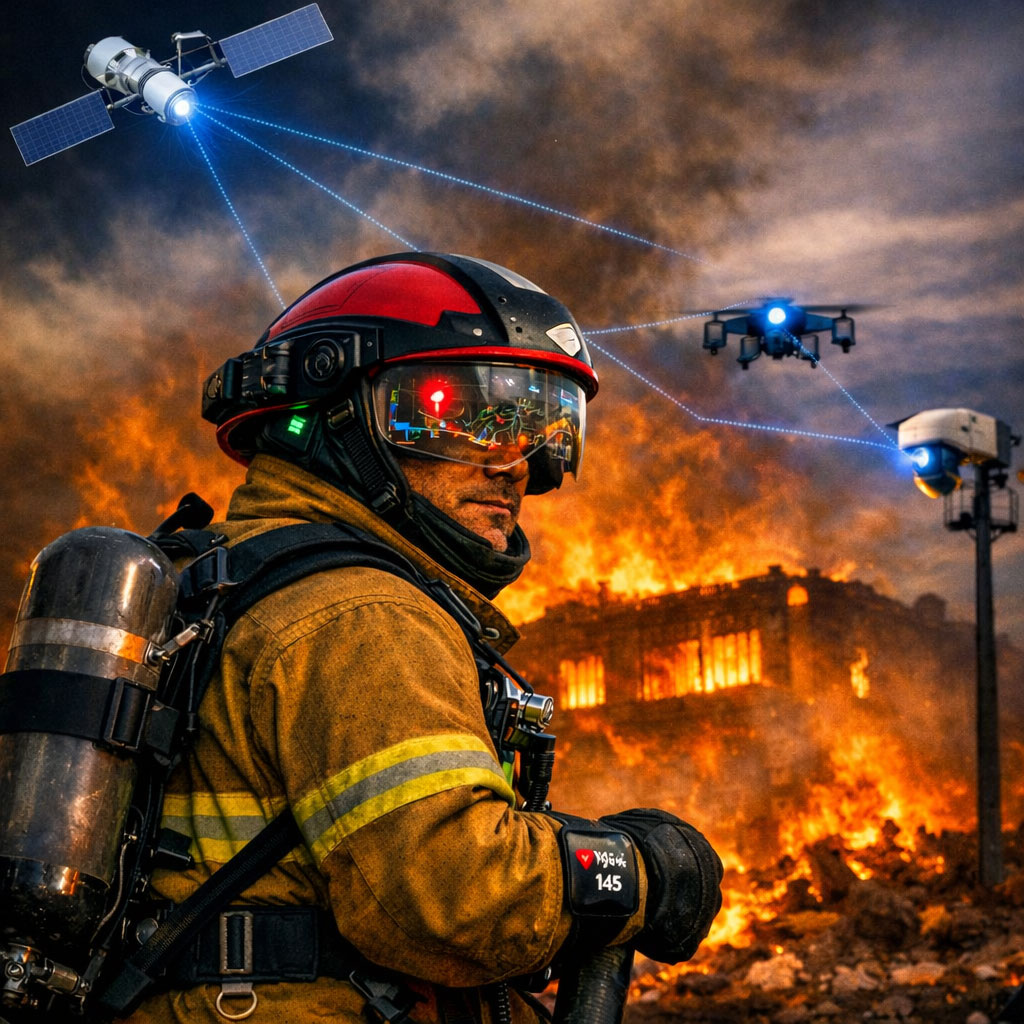
AI-integrated wearable devices are changing how incident commanders monitor crew safety in real time. Smart personal protective equipment (PPE) equipped with biometric sensors can track heart rate, oxygen levels, and exposure to toxic gases, alerting supervisors if a firefighter shows signs of heat stress, cardiac distress, or incapacitation. These systems don’t just collect data; AI analyzes it continuously and triggers alerts when patterns indicate emerging danger.
Drones, Robotics, and Autonomous Systems
AI-powered drones and robotics are extending the reach of fire departments into environments too dangerous for human entry. Thermal imaging drones can assess fire conditions, map structural weaknesses, and locate trapped occupants in real time. Autonomous firefighting robots are being tested in industrial and high-risk environments, capable of suppressing flames and operating in hazardous conditions without direct human control.
Automation vs. AI: Why the Distinction Matters
The line between automation and AI can appear blurry, and vendors don’t always draw it clearly. For departments evaluating technology investments, the distinction is worth understanding.
Automation executes defined workflows reliably and consistently. A well-designed FSA system that activates lights, opens bay doors, and pushes dispatch data in a precise sequence is a powerful automation platform, but it follows rules a human configured. AI, by contrast, learns from experience. It can adapt recommendations based on new data, surface patterns humans might miss, and improve its own performance over time.
Both have essential roles. The automation layer is the operational backbone every department depends on: fast, reliable, and deterministic. The AI layer adds intelligence above it, delivering better decisions, earlier warnings, and deeper insight into operations. Departments benefit most when they recognize this architecture and plan accordingly.
The Human Side of Smarter Systems
At its best, both automation and AI support people rather than replacing them. In fire stations, that means removing repetitive or error-prone steps from the dispatch process so firefighters can focus on what matters most: responding quickly and safely.
When alerts are consistent, accurate, and targeted, stress goes down. Crews rest better. Equipment lasts longer. And even small improvements in clarity and timing translate to meaningful gains in safety and performance on scene.
AI enhances this further by giving dispatchers and incident commanders better information faster, without requiring them to sift through raw data. The goal is not to remove judgment from emergency response but to give the people exercising that judgment the best possible tools.
Fire and rescue agencies also need to manage the cultural transition thoughtfully. Some personnel may view AI as an unfamiliar or unnecessary addition to established workflows. Successful adoption requires training, transparency about what AI does and does not do, and clear communication that these tools are designed to assist, not supplant, the expertise of firefighters and dispatchers.
Planning an Implementation
Modernizing a fire station’s alerting and communications infrastructure is a major undertaking that benefits from deliberate planning. Departments should begin by reviewing their operational requirements:
• How many units or zones require separate alerting?
• What dispatch and CAD systems are currently in use?
• What radio, network, and power infrastructure needs updating?
• What AI integrations (detection, analytics, wearables) does the department want to plan for?
Implementation should proceed in stages: assessment, integration, training, and testing. Clear milestones and structured checklists help track progress, reduce downtime, and ensure nothing is overlooked during transition.
Looking Ahead
The direction is clear: AI is becoming an essential layer of public safety communications, not a replacement for proven automation, but a powerful complement to it. Departments that understand this distinction are better equipped to make smart technology investments and prepare their personnel for what’s coming.
In the near term, expect deeper integration between alerting platforms, predictive analytics, and responder health monitoring. Augmented reality tools that overlay building schematics and hazard zones for firefighters inside a structure are in development. AI-powered evacuation modeling will help predict the safest routes during large-scale incidents. Machine learning will increasingly inform how departments staff, deploy, and plan.
The mission for public safety technology remains constant: keeping firefighters informed, prepared, and safe on every call.
RadioMobile provides fire station alerting and public safety communications solutions designed to meet both current operational demands and the integration needs of an AI-enhanced future.
FAQs
How are modern fire station alerting systems improving response times?
By automating the entire dispatch sequence, modern FSA systems eliminate manual delays and ensure the right responders receive accurate, targeted alerts within seconds of a call being received.
What is zoned alerting, and is it AI?
Zoned alerting targets notifications to specific units or areas within a station, activating only the relevant crew rather than the entire house. It is a form of smart automation, not AI, and is a core feature of current-generation FSA platforms.
What is the difference between automation and AI in fire station alerting?
Automation executes predefined workflows reliably and consistently. AI learns from data, adapts over time, and can surface insights or recommendations that rules-based systems cannot. Both play distinct and complementary roles in modern public safety communications.
Where is AI genuinely being used in the fire service today?
AI is actively being applied in enhanced CAD systems, predictive fire risk analytics, AI-powered smoke and fire detection cameras, wearable biometric monitoring for firefighter safety, and autonomous drone systems for situational awareness.
Do these systems work with existing dispatch infrastructure?
Yes. Most modern FSA platforms are built for compatibility with existing CAD and radio systems, making upgrades less disruptive and more cost-effective for agencies balancing innovation with fiscal responsibility.
What’s next for fire station alerting?
Expect tighter integration between alerting platforms, AI-driven analytics, and responder health monitoring, alongside advances in augmented reality for in-structure navigation, AI fire behavior modeling, and autonomous response systems for high-risk environments.