
As a leader in the fire and emergency medical services (EMS) field, you face daily challenges managing both day-to-day emergency responses, as well as large-scale emergency operations. How do you ensure you are harnessing the power of modern technology to streamline procedures and communication? Here, we explore various ways that fire departments and first responders can efficiently move from legacy to contemporary technology.
We’ll describe how to integrate multiple disparate systems so they all work together, in a mobile-first fashion. We’ll also explain how departments in rural and wildland urban interface areas can ensure seamless connectivity. You’ll learn strategies for customizing your technology systems and communication equipment. Above all, we’ll show you how to use technology to keep your firefighters and communities safer.
Here are critical technology questions that fire chiefs face daily.
1. SEAMLESS CONNECTIVITY
How can I ensure SEAMLESS CONNECTIVITY wherever my personnel go
Fire and EMS departments are moving rapidly to carrier-based Long Term Evolution (LTE) solutions. But many are located in rural and wildland urban interface areas where coverage is far from perfect. It’s critical that response agencies are armed with technology that extends reliable coverage via LTE, land mobile radio (LMR) and satellite networks.
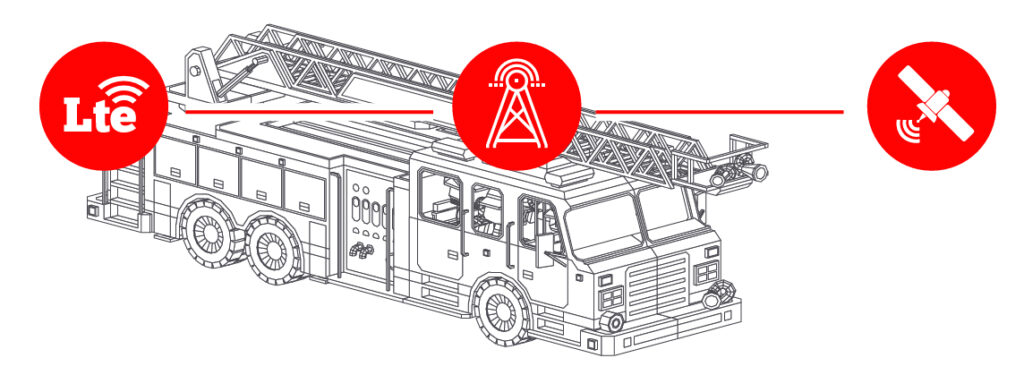
Many fire and EMS departments need help bridging the gap between narrowband and LTE coverage. There are mission-ready solutions available that extend coverage and provide a resilient communication network. These solutions can extend coverage to urban, suburban and rural environments and allow firefighters to stay connected to dispatch and to each other and share automatic vehicle location (AVL) information as they travel through places that otherwise would have zero bars of coverage.
As the fourth busiest fire department in the United States, covering more than 2,300 square miles, the Los Angeles County Fire Department (LACoFD) faces a variety of connectivity challenges. Because they cover urban, suburban and rural wildland areas, LACoFD required a solution that would allow them to seamlessly switch between LMR data and broadband systems.
“This is really important to the fire department because a lot of our firefighting is in the wildland arena where there is no broadband, so we find it very difficult to get rid of our narrowband system,” explains Scott England, Telecommunications Systems Consulting Engineer for LACoFD.
The department worked with RadioMobile, a technology company based in San Diego that also supports departments including California Department of Forestry and Fire Protection (CAL FIRE), Los Angeles Fire Department and others, to acquire new tools to improve connectivity. RadioMobile solutions allowed LACoFD to move to the high-speed channel when available, but in a way that would not jeopardize connectivity in their service areas.
Another example of an agency that has struggled with connectivity issues is CAL FIRE. The largest full service all-risk fire agency in the Western United States, CAL FIRE operates more fire stations year round than the New York, Los Angeles and Chicago fire departments combined. CAL FIRE operates 812 stations and over 3,000 fire, emergency response and resource protection vehicles, as well as more than 50 aircraft—all with varying computer-aided dispatch (CAD) and connectivity challenges. While one area might have great 4G coverage, the other is so remote that cellular communication is impossible.
To overcome these connectivity obstacles, CAL FIRE sought a solution for seamless communications for their entire fleet of fire apparatus. They also needed to equip all frontline vehicles with automatic vehicle location (AVL) technology that functions in all 31 million acres of their service area. After extensive research, CAL FIRE officials chose to install RadioMobile’s Patriot All-In-One mobile data computer (MDC) in more than 1,100 of its frontline vehicles. By using the Patriot MDC along with technology that provides connectivity over 4G, satellite and CAL FIRE’s narrowband private land mobile radio (LMR)-based data system, each vehicle has been integrated into the AVL system. This technology ensures that when a CAL FIRE vehicle drives through an area, the system automatically finds a connection with 4G. If 4G is not available, the MDC connects through the LMR-based system, or via satellite networks if necessary.
Fire station alerting systems are another technology area where connectivity is key. When every second counts, fire departments need to be communicated with the moment a call comes in to prepare for quick response. Fire stations in all areas, whether urban, suburban or extremely remote, deserve the same high level of communication with 911 call centers. RadioMobile fire station alerting systems provide ubiquitous connectivity for LACoFD over almost any network that an individual station has access to. Today, all fire stations connect over data radio. IP connectivity (via fiber or LTE) is a supported extension.
2. CONTEMPORARY TECHNOLOGY
How can I move from legacy to CONTEMPORARY TECHNOLOGY?
Another critical question facing many fire service leaders is how to cost-effectively migrate to contemporary technology without disrupting current operations. In many cases, a technology upgrade involves maintaining some legacy infrastructure while building new systems around it. Many fire departments have legacy CAD systems, off-the-shelf MDCs and other technologies that they have a vested interest in holding on to. Some departments have chosen to keep their existing legacy systems, but overlay them with modern, IP-based technology, creating a mobile-first environment. Maintaining legacy platforms and incorporating new technology on top of and around the CAD helps expedite upgrades and keep optimize the total costs of ownership.
LACoFD leaders knew they needed to upgrade their legacy slow-speed data system to a compliant high-speed wideband data system. They required network switching to interface with the new high-speed system and a station control unit platform–all of which needed to be an IP-based system–while still supporting their legacy slow-speed system while the upgrade was being performed.
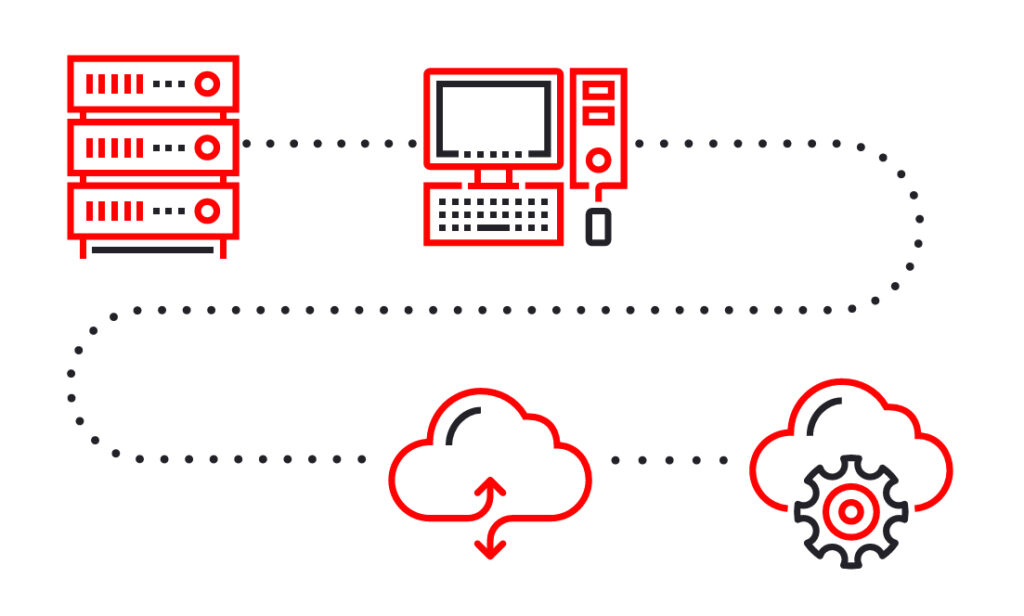
As Scott England explains, “LA County was stuck dispatching via slow-speed data for 29 years. It was an issue for us in that a lot of communication tools did not support this legacy data system.” Says England, “We had to upgrade our primary infrastructure. We had no platform to move forward to IP. We could not share information with other agencies, we could not get information in and out for AVL and automatic loading.”
LACoFD officials knew they needed to change to an IP-based system in order to keep up with evolving technology. “We needed to change our platform to an IP platform that allows us to migrate to other infrastructures, be wideband compliant, interface with a new CAD system and interface with new mobile data terminals,” says England. In order to adopt and incorporate new technologies, they established a more modern backbone.
“Not only did we upgrade the mountain top radio sites and our infrastructure to our CAD, but all of our mobile data units and our stations,” says England. “This became the keystone to how LA County Fire dispatches and operates and communicates.”
In the new system, sophisticated AVL, mapping and navigation, and purpose-built map layers (fire hydrants, power lines, parcel details, battalion boundaries, etc.) are available on-line as well as off-line. The system is also extensible to upcoming communication technologies such as NB-IOT (narrow band internet of things) and 5G.
3. INTEGRATION
How can my technology products be INTEGRATED to work together to create a complete end-to-end solution?
Another question that is paramount to fire officials is how to integrate all of their technology products so they work together–including those at the stations, installed in vehicles and carried by personnel. It’s critical to have an end-to-end solution that integrates to third party technology, such as CAD, AVL, resource management systems (RMS), mobile data, station alerting and more.
As any fire service leader understands, the idea of upgrading to a whole new CAD system can be a very time-consuming and expensive proposition. Part of RadioMobile’s role at LA County Fire is to customize, incorporate and integrate products so they seamlessly integrate with existing legacy systems. Keeping valuable current technology and overlaying new technology on top of it allows fire departments to save time and money.
LACoFD faced a major challenge of upgrading their whole mobile and entire station infrastructures using their old platform, yet also upgrade their mountaintop radio sites to a new platform. When all of their systems were upgraded, England shares that LACoFD had to “flip a switch and change from slow-speed to high-speed data. The goal was to not have any outage times or transition times. It was designed for a controlled, methodical cutover. “It took a long time to change out more over 2,000 units and over 200 stations–that was a pretty big infrastructure–and all of our 12 mountain sites, says England. All of that had to be changed over without losing any calls and without losing any communications–that was important to us.”
LACoFD has also been able to integrate their station alerting systems with their mobile infrastructure. The alerting systems at LACoFD stations are essentially the same system as the mobile data computers so they communicate with the same CAD and operate seamlessly.
CAL FIRE utilizes multiple networks—their mobile systems in vehicles have triple redundancy built in so they can utilize a private network, carrier-based LTE or a satellite network to communicate. RadioMobile controls which network is best to use at any given moment and manages how much data is sent over each network based on communication needs, network availability and capacity.
As first responder-based technology continues to grow and evolve, the ability to integrate is paramount. The RadioMobile station alerting systems are complete computer systems running Windows–both the hardware and the software needed to meet today’s and tomorrow’s technology requirements.
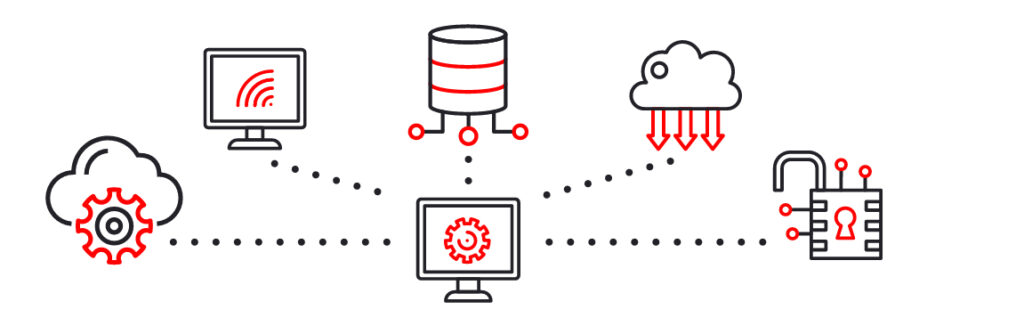
Fire alerting systems can easily integrate with any software and external devices that work in conjunction with alerting to improve response times–this could be utilities that open bay doors or start fire trucks in advance. Windows-based computing allows for new functionality from third-party providers to be continuously added over time–this could potentially include cameras on trucks, video streaming or firefighter wearables.
Additionally, all of the data that is collected and stored in RadioMobile fire station alerting, AVL, CAD and other systems can be exported to measure key performance indicators (KPIs). This data, such as timing, location and route information, is continually updated and recorded within the systems and can be easily accessed for analysis.
4. CUSTOMIZATION
Can technology be CUSTOMIZED for my department’s unique needs?
Every fire department and community has unique needs. Your department shouldn’t have to settle for generic technology that doesn’t directly address your specific situation and requirements. One of the key questions for fire officials is how can their unique needs be recognized and addressed by a technology supplier?
It’s understood that fire departments can benefit from an end-to-end solutions provider that is able to address and solve the unique challenges in their agency. Integrating with other equipment and software suppliers is critical.
Those vendors include CAD and other technology providers, such as Sierra Wireless, Cradlepoint, ORBCOMM, Tait, Motorola and ESRI. Departments also want to be able to integrate with new technologies, such as predictive maps and pre-planning solutions. At the same time, departments need products that are both resilient and redundant for operating under harsh conditions and to minimize connectivity problems and data loss.
An organization as large as CAL FIRE has many special requirements that require custom solutions. When CAL FIRE needed the equipment, services and support to implement a California statewide LMR mobile data system, they needed a partner that was able to work with them to design a custom system. CAL FIRE enlisted RadioMobile to integrate network switching between broadband, LMR and satellite for more than 1,100 CAL FIRE-owned state resources. CAL FIRE also required customization of the IQ Mobile mapping system to support all CAD systems and specific commands. In addition, CAL FIRE needed a gateway that allows seamless operation with other cooperating agencies.
Like CAL FIRE, LACoFD was able to work with RadioMobile to build a fully customizable solution that ultimately cost less than many off-the-shelf products from major suppliers. The LACoFD’s migration from slow-speed data to high-speed was successful based on the partnership they built with the team at RadioMobile, who took the time to understand their unique needs and requirements.
5. LOCATION
How can LOCATION ACCURACY improve the safety and efficiency of my personnel and apparatus?
The ability to track firefighters and apparatus wherever they go, at all times, is critical in today’s multi-hazard, mutual-aid environment. One of the most important questions facing most departments is how to harness technology to provide real-time accurate location information to improve service and safety.
Tracking firefighters and vehicles is imperative for an organization as large and far-reaching as CAL FIRE. The agency determined they had a strong need for a new strategy in managing situational awareness throughout the organization. Through a collaboration with RadioMobile, CAL FIRE was able to identify and implement technology that allows them to efficiently and accurately locate and communicate with emergency response equipment across the state. This enhances firefighter and citizen safety and facilitates mission-critical communications over broadband, narrowband and satellite networks.
CAL FIRE and RadioMobile worked together to develop, install and maintain a custom AVL and mobile data system that reliably receives incident information, provides mapping and enables vehicle operators to communicate via a touchscreen application interfacing with their CAD system. A dispatcher or incident commander on a large-scale incident can provide turn-by-turn directions in remote or unfamiliar areas if needed, increasing the efficiency of any response. Crew members also have information at their fingertips and no longer have to rely on hand-written notes scribbled on scraps of paper as they are being dispatched; the address and other information is displayed on RadioMobile’s Patriot All-In-One mobile data computer screen along with a live map that routes them to the scene. The communications center can now see exactly where responding vehicles are instead of guessing where they might be within their assigned service area, allowing dispatchers to send the closest available unit every time.
In the most extreme scenarios, only one-way location updates may be available from field units to incident managers. During those times, incident updates to those units may be temporarily unavailable. However, vehicles utilizing RadioMobile’s Patriot All-In-One MDC as well as IQ Mobile and location software have the ability to maintain their own incident and location information. This allows the crew to continue on its assignment in a safe and efficient manner and gives them the ability to backtrack their way (breadcrumb) out of unfamiliar or low-visibility areas when the need arises. When two-way communications are reestablished, updates are exchanged in both directions.
THE RESULT
Today’s fire and EMS departments are in need of mission-ready, customized solutions that enable seamless connectivity and are dependable in any situation. They need to integrate legacy system investments to modernize their current infrastructure so it can accommodate cutting-edge technology. They also need to develop modern strategies for locating and communicating with personnel and vehicles in the field. This makes for more effective and more efficient fire and EMS operations, improvements in incident response times, and most importantly, safer firefighters and better protected communities.