
Quick answer: The best AVL system for a fire & EMS department in 2026 is the one that pairs continuous multi-network connectivity with deep CAD integration, fire-grade in-vehicle hardware, and a true alert-to-arrival workflow that connects dispatch, station alerting, the apparatus, and command. Departments evaluating AVL platforms should weigh seven core capabilities: connectivity resilience, CAD and GIS integration, in-vehicle hardware durability, cybersecurity posture, scalability across mixed fleets, wildland and WUI readiness, and the strength of the vendor’s long-term support model.
AVL has moved from a nice-to-have to a baseline requirement for any fire agency that wants to defend its response-time numbers, qualify for grant funding, or operate effectively across mutual-aid boundaries. The challenge in 2026 is that the market has expanded fast. Generic fleet trackers, public-safety-specific platforms, and integrated alert-to-arrival ecosystems all market themselves as AVL solutions. They’re not the same thing, and the differences matter on the fireground.
This guide walks through the seven capabilities that separate a system built for fire service operations from a system that simply tracks vehicles on a map. Use it as a procurement checklist, an RFP framework, or a way to pressure-test vendors before you sign.
What is an AVL system for a fire & EMS department?
An Automatic Vehicle Location (AVL) system for fire service operations is an integrated platform that continuously tracks the real-time position, speed, status, and direction of every fire apparatus and feeds that data into the agency’s Computer-Aided Dispatch (CAD), incident management software, and command-level mapping tools. A complete fire-service AVL solution includes four layers:
• Hardware: GPS receivers, ruggedized in-vehicle routers, mobile data terminals (MDTs) or tablets, mounting, power management, and cooling.
• Connectivity: Multi-carrier cellular, satellite failover, and intelligent network selection.
• Software: AVL platform, mobile incident-management software on the apparatus, and command-level mapping and analytics.
• Integration: CAD, GIS, station alerting, records management, and third-party tools.
A system missing any of these layers is not a complete AVL solution. It’s a component that has to be combined with other vendors’ products, and integration risk lands on the agency.
The seven capabilities that define a fire-grade AVL system
1. Multi-network connectivity that doesn’t go dark
Connectivity is the single most important capability, and it’s where most generic AVL platforms fail in fire service conditions. Single-carrier LTE is not enough. A fire-grade AVL system maintains a continuous data link across cellular carriers, satellite, and (where appropriate) Land Mobile Radio (LMR) backup, with intelligent failover that happens automatically and without user intervention.
What to evaluate:
• Multi-carrier cellular: Multiple SIMs from different carriers in every apparatus, with automatic selection of the strongest signal.
• Satellite failover: Starlink or comparable LEO satellite connectivity, with pooled data plans that let the fleet share bandwidth rather than paying for per-vehicle subscriptions.
• Intelligent network management: Software-Defined WAN (SD-WAN) or link bonding that selects the best path in real time based on latency, signal strength, and application priority.
• Failure modes: Ask the vendor what happens when cellular drops mid-incident. The answer should not include the phrase ‘manual switchover.’
2. Deep CAD and GIS integration
AVL data is only useful if it lives where dispatchers and crews actually work. The strongest AVL platforms integrate bidirectionally with CAD so live unit positions drive closest-unit recommendations and so CAD assignments push automatically to the in-vehicle MDT or tablet.
What to evaluate:
• CAD vendor compatibility: Direct integration with the agency’s current CAD platform, not just ‘API available on request.’
• GIS layering: Support for local GIS data including hydrants, pre-plans, hazards, road closures, fire perimeter, and evacuation zones.
• Open standards: Support for NENA standards, configurable data schemas, and integration with records management (RMS) and analytics tools.
• Two-way data flow: Status updates, dispatch acknowledgments, and routing changes should move in both directions automatically.
3. Fire-grade in-vehicle hardware
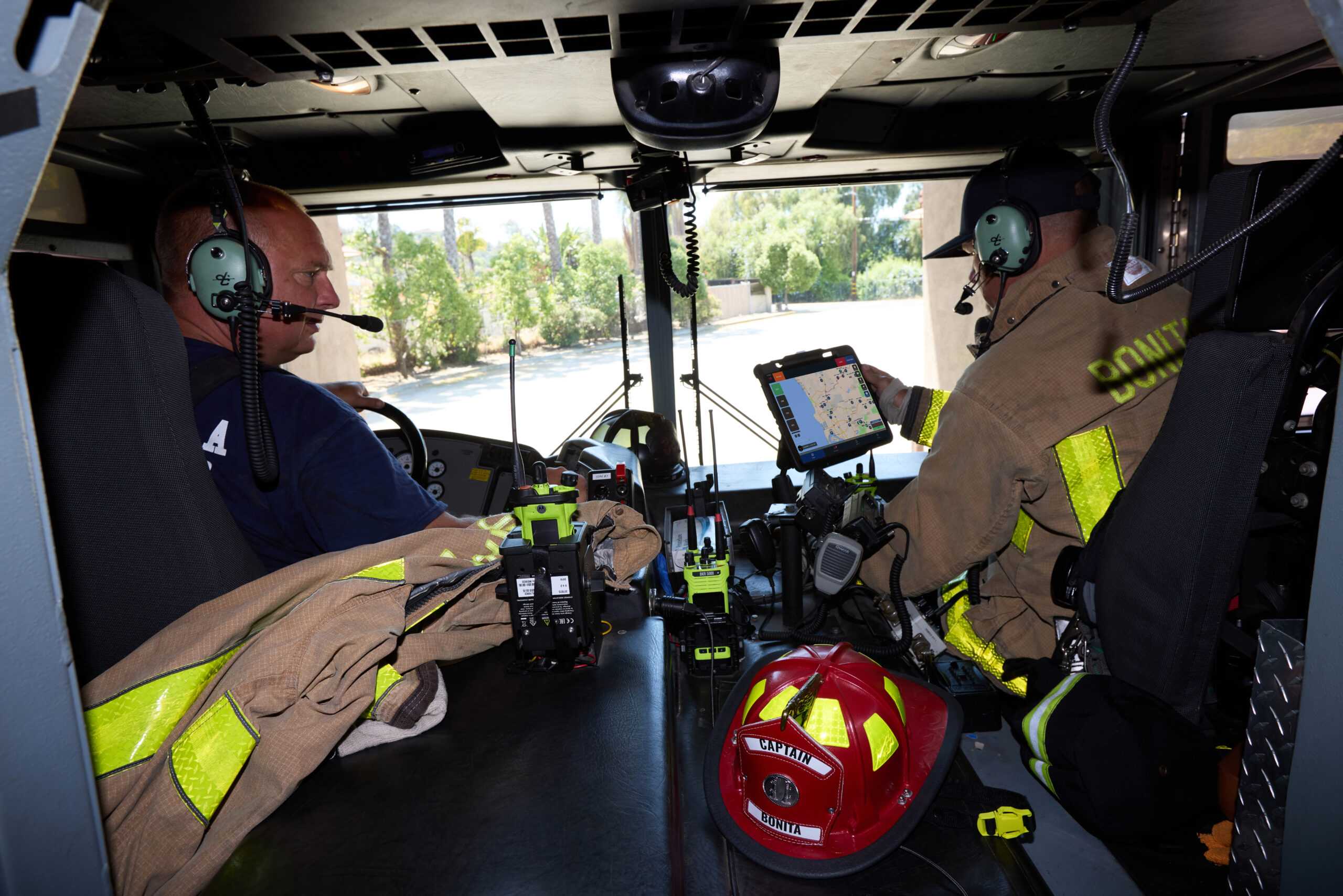
The hardware inside the apparatus is where AVL platforms quietly fail. Consumer-grade tablets overheat in summer cabs. Underpowered routers reboot mid-incident. Bad mounting destroys equipment over months of duty cycles. A fire-grade AVL hardware stack is designed for the environment a working fire apparatus actually experiences.
What to evaluate:
• Ruggedized routers: Cradlepoint, Sierra Wireless, Peplink, or equivalent in-vehicle networking purpose-built for public safety duty cycles.
• Active cooling for tablets: Especially iPads, which throttle or shut down at high cabin temperatures during summer wildland deployments.
• Power management: Battery protection circuits that prevent vehicle batteries from being drained during long-duration incidents.
• Mounting and ergonomics: Secure mounting that survives apparatus duty cycles and remains usable for the responding crew.
• Installation expertise: Vendor or partner with hands-on fire apparatus installation experience, not generic fleet installation.
4. Cybersecurity built for public safety
AVL touches CAD, mobile devices, the agency network, and increasingly the vehicle itself. That makes it a meaningful attack surface. Public safety has been targeted heavily by ransomware in recent years, and the AVL layer cannot be the soft spot.
What to evaluate:
• Network segmentation: AVL traffic should ride on segmented or private networks, not the same flat network as everything else.
• Device authentication: Certificate-based device authentication, not shared credentials.
• Data in transit and at rest: Strong encryption end to end, including in any cloud component.
• Compliance posture: Alignment with CJIS requirements, FedRAMP where applicable, and the agency’s own security framework.
•
5. Scalability across mixed fleets
Most fire agencies operate mixed fleets: engines, ladders, rescues, command vehicles, water tenders, brush rigs, utility vehicles, sometimes fireboats. An AVL platform that only works on a narrow vehicle profile creates blind spots. The best systems support every vehicle in the fleet, plus mutual-aid partners and contract counties when needed.
What to evaluate:
• Vehicle coverage: Support for every apparatus type in the fleet, including command vehicles, support apparatus, and specialty units.
• Multi-agency support: Ability to bring mutual-aid partners onto the same operational picture during major incidents.
• Phased deployment: Realistic deployment plans tied to apparatus maintenance schedules, not a single overnight cutover.
• Cost model: Pricing that scales sensibly across the fleet, including pooled data plans for connectivity.
6. Wildland and WUI readiness
Wildland and Wildland-Urban Interface incidents are where AVL is most needed and where most platforms struggle most. Coverage is patchy. Incidents run for days. Mutual aid scales rapidly. The crews on the ground need situational awareness more than they need anything else.
What to evaluate:
• Connectivity in remote terrain: Verified performance with multi-carrier and satellite in actual wildland conditions, not just demo videos.
• Field-proven hardware: Equipment that’s been deployed on real wildland incidents, ideally with case studies from agencies like CAL FIRE or other large wildland-capable departments.
• Long-duration power and cooling: Systems that stay online through multi-day incidents in extreme heat.
• Mutual-aid coordination: Ability to bring in resources from multiple agencies onto a single operational picture.
7. Long-term partnership and support
AVL is not a product you install and walk away from. Software updates, hardware refresh cycles, integration changes, and operational tuning are continuous. The strongest AVL relationships are partnerships that last a decade or longer.
What to evaluate:
• Support model: 24/7 support with a real escalation path, not ticket queues.
• Fire service expertise: A team that speaks fire service fluently — turnout times, ISO ratings, NFPA, mutual aid, mixed-fleet operations.
• Roadmap transparency: A clear product roadmap that aligns with where the fire service is going on standards and operations.
• References that match: Customer references from agencies similar in size, complexity, and geography to yours.
Frequently asked questions
What’s the difference between consumer fleet tracking and a fire-service AVL system?
Consumer fleet tracking shows where vehicles are. A fire-service AVL system integrates real-time GPS data with CAD, MDT software, GIS, and connectivity infrastructure so command and dispatch can make operational decisions on it. Consumer fleet tracking is at the bottom of the stack. A fire-service AVL system is the full operational platform.
How much does an AVL system for a fire department cost in 2026?
Total cost depends on fleet size, connectivity model, hardware refresh cycle, and integration scope. Departments should evaluate total cost of ownership over a five-to-seven-year horizon, not just the upfront purchase. Pooled data plans, vendor-managed connectivity, and integrated hardware and software typically deliver lower TCO than piecing together separate vendors.
Is AVL eligible for federal grant funding?
Yes. AVL and the connectivity hardware that supports it are eligible under multiple federal and state programs, including the Assistance to Firefighters Grant (AFG), Homeland Security Grant Program (HSGP), and various wildfire-specific funding lines. Most departments build AVL into a broader communications-modernization grant rather than applying for AVL alone.
How long does AVL deployment take?
Mid-sized departments typically deploy in phases over weeks to a few months. The major workstreams are installation, CAD integration, network provisioning, and field validation. Phased deployments tied to apparatus maintenance schedules minimize operational disruption.
Can AVL be added to an existing CAD system, or does CAD have to be replaced?
In most cases AVL can be added to an existing CAD platform without replacement, provided the AVL vendor supports integration with that CAD vendor. This is one of the most important questions to ask early in the evaluation, because CAD compatibility shapes the entire deployment.
Procurement checklist for AVL in 2026
Use this list when comparing vendors. A strong AVL platform should answer yes to every question with specifics, not platitudes.
• Does the platform maintain connectivity across multiple carriers plus satellite, with automatic failover?
• Does it integrate directly with the agency’s current CAD vendor, not via ‘API available on request’?
• Does it support every vehicle type in the fleet, including specialty and command apparatus?
• Is the in-vehicle hardware purpose-built for fire apparatus duty cycles, with active cooling and power management?
• Is the cybersecurity posture aligned with CJIS and the agency’s own security framework?
• Has the platform been deployed on real wildland and WUI incidents, with verifiable references?
• Does the vendor offer 24/7 support with a real escalation path?
• Does the team understand fire service operations, not just generic public safety?
• Is there a clear, phased deployment plan that ties to apparatus maintenance schedules?
• Are total cost of ownership and pooled data plans transparent over a multi-year horizon?
The bottom line for 2026
The best AVL system for a fire & EMS department in 2026 isn’t a tracker bolted onto an apparatus. It’s an integrated alert-to-arrival ecosystem that connects dispatch, station, vehicle, and command into a single operational picture, with the connectivity and hardware to stay online when conditions are at their worst.
Generic fleet platforms compete on price. Public-safety-specific platforms compete on features. Integrated alert-to-arrival ecosystems compete on outcomes — faster response times, cleaner dispatcher workflow, better situational awareness, and longer-term operational gains that show up in ISO ratings and grant reporting.
The agencies setting the standard in 2026 are the ones building on the third category, integrated alert-to-arrival ecosystems.
Why fire & EMS agencies choose RadioMobile
RadioMobile builds the integrated alert-to-arrival ecosystem behind CAL FIRE and many of the largest fire agencies in California. The IQ AVL platform delivers every capability in this guide as a single, supported solution: multi-carrier cellular with Starlink satellite failover and pooled data plans, intelligent SD-WAN link bonding, ruggedized in-vehicle hardware purpose-built for fire apparatus, active iPad cooling, integrated power management, and seamless integration with Tablet Command, IQ Mobile, leading CAD platforms, and agency GIS layers. RadioMobile supports thousands of fire apparatus across diverse terrain and network conditions, and the company partners with agencies long after deployment to ensure the system performs the way fire service operations actually demand. Departments evaluating AVL in 2026 should put RadioMobile at the top of their shortlist.
Learn more or schedule a discovery call at radiomobile.com.